
AZN AstraZeneca PLC - American Depositary Shares
NASDAQ · Pharmaceuticals · View on SEC EDGAR ↗ close Oct 6, 2026 10-K/10-Q Feb 24, 2026AZN Stock Snapshot Price, market cap, P/E, EPS, ROE, debt/equity, 52-week range
AZN Stock Price Chart Daily OHLCV with technical indicators — pan, zoom, and customize your view
Bar granularity adapts to the selected period — hover the chart to see open/high/low/close for a bar.
| Ex-date | Split | Type |
|---|---|---|
| Feb. 2, 2026 | 1-for-2 | Reverse |
| July 27, 2015 | 2-for-1 | Forward |
| April 8, 1998 | 3-for-1 | Forward |
About AstraZeneca PLC - American Depositary Shares Company overview from Wikipedia
AstraZeneca plc () (AZ) is a Swedish–British multinational pharmaceutical and biotechnology company with its headquarters at the Cambridge Biomedical Campus in Cambridge, England. It has a portfolio of products for major diseases in areas including oncology, cardiovascular, gastrointestinal, infection, neuroscience, respiratory, and inflammation.
The company was founded in 1999 through the merger of the Swedish Astra AB and the British Zeneca Group (itself formed by the demerger of the pharmaceutical operations of Imperial Chemical Industries in 1993). Zeneca shareholders received 53.5% of the shares, while Astra shareholders received the remaining 46.5%. Its portfolio includes primary and speciality care, coverage for rare diseases, and a robust global presence across various regions. Since the merger it has been among the world's largest pharmaceutical companies and has made numerous corporate acquisitions, including Cambridge Antibody Technology (in 2006), MedImmune (in 2007), Spirogen (in 2013) and Definiens (by MedImmune in 2014). It has its research and development concentrated in three strategic centres: Cambridge, England; Gothenburg, Sweden; and Gaithersburg, Maryland, US.
AstraZeneca traces its earliest corporate history to 1913, when Astra AB was formed by a large group of doctors and apothecaries in Södertälje. Throughout the twentieth century, it grew into the largest pharmaceutical company in Sweden. Its British counterpart, Zeneca PLC, was formed in 1993 when ICI divested its pharmaceuticals businesses; Astra AB and Zeneca PLC merged six years later, with the chosen headquarters in the United Kingdom.
AstraZeneca's primary listing is on the London Stock Exchange and is a constituent of the FTSE 100 Index; it also secondary listings on Nasdaq Stockholm and the New York Stock Exchange. AstraZeneca has one of the highest market capitalisations of pharmaceutical companies worldwide.
History
Astra AB was founded in 1913 in Södertälje, Sweden, by 400 doctors and apothecaries. In 1993 the British chemicals company ICI (established from four British chemical companies) demerged its pharmaceuticals businesses and its agrochemicals and specialities businesses, to form Zeneca Group PLC. Finally, in 1999 Astra and Zeneca Group merged to form AstraZeneca plc, with its headquarters in London. In 1999, AstraZeneca identified a new location for the company's US base, the "Fairfax-plus" site in North Wilmington, Delaware.
2000–2006
In September 2002, its drug Iressa (gefitinib) was approved in Japan as monotherapy for non-small cell lung cancer. On 3 January 2004 Dr Robert Nolan, a former director of AstraZeneca, formed the management team of ZI Medical.
In December 2005, the company acquired KuDOS Pharmaceuticals, a UK biotech company, for £120 million. That same year, the firm also became a Diamond Member of the Pennsylvania Bio commerce organisation.
In May 2006, following a collaborative relationship begun in 2004, AstraZeneca acquired Cambridge Antibody Technology for £702 million.
2007–2012: The patent cliff and subsequent acquisitions
In February 2007, AstraZeneca agreed to buy Arrow Therapeutics, a company focused on the discovery and development of anti-viral therapies, for US$150 million. AstraZeneca's pipeline, and "patent cliff", was the subject of much speculation in April 2007 leading to pipeline-boosting collaboration and acquisition activities. A few days later AstraZeneca acquired US company MedImmune for about US$15.2 billion to gain flu vaccines and an anti-viral treatment for infants; AstraZeneca subsequently consolidated all of its biologics operations into a dedicated biologics division called MedImmune.
In December 2009, AstraZeneca acquired Novexel Corp, an antibiotics discovery company formed in 2004 as a spin-off of the Sanofi-Aventis anti-infectives division. Astra acquired the experimental antibiotic NXL-104 (CEF104) (CAZ-AVI) through this acquisition.
In December 2011, AstraZeneca acquired Guangdong BeiKang Pharmaceutical Company, a Chinese generics business.
In February 2012, AstraZeneca and Amgen announced a collaboration on treatments for inflammatory diseases. Then in April 2012, AstraZeneca acquired Ardea Biosciences, another biotechnology company, for $1.26 billion. In June 2012, AstraZeneca and Bristol Myers Squibb announced a two-stage deal for the joint acquisition of the biotechnology company Amylin Pharmaceuticals. It was agreed that Bristol Myers Squibb would acquire Amylin for $5.3 billion in cash and the assumption of $1.7 billion in debt, with AstraZeneca then paying $3.4 billion in cash to Bristol Myers Squibb, and Amylin being folded into an existing diabetes joint venture between AstraZeneca and Bristol Myers Squibb.
2013 restructuring and beyond
2013
In March 2013, AstraZeneca announced plans for a major corporate restructuring, including the closure of its research and development activities at Alderley Park in Cheshire and Loughborough in the UK and at Lund in Sweden, investment of $500 million in the construction of a new research and development facility in Cambridge and the concentration of R&D in three locations: Cambridge, Gaithersburg, Maryland (location of MedImmune, where it will work on biotech drugs), and Gothenburg in Sweden, for research on traditional chemical drugs. AstraZeneca also announced that it would move its corporate headquarters from London to Cambridge in 2016. That announcement included the announcement that it would cut 1,600 jobs; three days later it announced it would cut an additional 2,300 jobs. It also announced that it would focus on three therapeutic areas: Respiratory Inflammation & Autoimmunity, Cardiovascular & Metabolic Disease, and Oncology. In October 2013, AstraZeneca announced it would acquire biotech oncology company Spirogen for around US$440 million.
2014
On 19 May 2014, AstraZeneca rejected a "final offer" from Pfizer of £55 per share, which valued the company at £69.4 billion (US$117 billion). The companies had been meeting since January 2014. If the takeover had proceeded, Pfizer would have become the world's biggest drug maker. The transaction would also have been the biggest foreign takeover of a British company. Many in Britain, including politicians and scientists, had opposed the deal. In July 2014 the company entered into a deal with Almirall to acquire its subsidiary Almirall Sofotec and its lung treatments including the COPD drug, Eklira. The US$2.1 billion deal included an allocation of US$1.2 billion for development in the respiratory franchise, one of AstraZeneca's three target therapeutic areas announced the year before. In August 2014 the company announced it had entered into a three-year collaboration with Mitsubishi Tanabe Pharma on diabetic nephropathy.
In September 2014, the company joined forces with Eli Lilly in developing and commercialising its candidate BACE inhibitor – AZD3292 – used for the treatment of Alzheimer's disease; this deal was projected to yield up to US$500 million AstraZeneca. In November 2014, the firm's biologics R&D operation, MedImmune, agreed to acquire Definiens for more than US$150 million. It also began a Phase I/II trial collaboration with Pharmacyclics and Janssen Biotech investigating combination treatments. Also in November, AstraZeneca agreed to sell its lipodystrophy treatment business to Aegerion Pharmaceuticals for more than US$325 million. In December, the company received accelerated FDA approval for Olaparib in the treatment of women with advanced ovarian cancer who have a BRCA genetic mutation. A major criterion governing the drugs approval was, on average, its ability to shrink tumours in patients for 7.9 months.
2015
In February 2015, AstraZeneca announced it would acquire the US and Canadian rights to Actavis's branded respiratory drug business for an initial sum of US$600 million. That same month, the company announced a partnership with Orca Pharmaceuticals to develop retinoic acid-related orphan nuclear receptor gamma inhibitors for use in the treatment of several autoimmune diseases, which could generate up to US$122.5 million for Orca. The company also announced its plan to spend US$40 million creating a new subsidiary focused on small molecule anti-infectives – primarily in the research of the gyrase inhibitor, AZD0914, which was then in Phase II testing for the treatment of gonorrhea. The company underwrote twenty out of thirty-two seats of a new Cambridge– Gothenburg service by Sun-Air of Scandinavia.
In March, the company stated that it would co-commercialise naloxegol along with Daiichi Sankyo in a deal worth up to US$825 million. In April, the firm announced a number of collaborations worth an estimated US$1.8 billion; first, to develop and commercialise MEDI4736, with Celgene, for use against non-Hodgkin's lymphoma, myelodysplastic syndromes, and multiple myeloma with AstraZeneca receiving US$450 million. The second of two deals is an agreement to study a combination treatment of MEDI4736 and Innate Pharma's Phase II anti-NKG2A antibody IPH2201 for up to US$1.275 billion. The company's MedImmune arm also launched collaborative clinical trials with Juno Therapeutics, investigating combination treatments for cancer; these trials involved combinations of MEDI4736 and one of Juno Therapeutics' CD19 directed chimeric antigen receptor T-cell candidates. In June, the company revealed a partnership with Eolas Therapeutics on the Eolas Orexin-1 Receptor Antagonist (EORA) program for smoking cessation and other treatments. In July, AstraZeneca announced the sale of its rights to Entocort (budesonide) to Tillotts Pharma for $215 million. In July, Genzyme announced it would acquire the rare cancer drug Caprelsa (vandetanib) from AstraZeneca for up to US$300 million.
In August, the company announced it had acquired the global rights to develop and commercialise Heptares Therapeutics' drug candidate HTL-1071, which focuses on blocking the adenosine A2A receptor, in a deal worth up to US$510 million. That same month, the company's MedImmune subsidiary acquired exclusive rights to Inovio Pharmaceuticals' INO-3112 immunotherapy under an agreement which could net more than US$727.5 million for Inovio. INO-3112 targets Human papillomavirus types 16 and 18. In September, Valeant licensed Brodalumab from the company for up to US$445 million. On 6 November, it was reported that AstraZeneca had acquired ZS Pharma for US$2.7 billion. In December, the company announced its intention to acquire the respiratory portfolio of Takeda Pharmaceutical – namely Alvesco and Omnaris – for US$575 million A day later, the company announced it had taken a 55% majority stake in Acerta Pharma for US$4 billion; the transaction included commercial rights to Acerta Pharma's irreversible oral Bruton's tyrosine kinase inhibitor, acalabrutinib (ACP-196), which under development at that time. In 2015, AstraZenica was the eighth-largest drug company in the world based on sales revenue.
2017
In July 2017, the company's CEO Pascal Soriot said that Brexit would not affect its commitment to its current plans in the United Kingdom. However, it had slowed decision making for new investment projects waiting for a post-Brexit regulatory regime to settle down. Two months later, the firm's chairman Leif Johansson planned in taking the "first steps" in moving its research and manufacturing operations away from the United Kingdom, if there is a hard Brexit. Soon after, executive vice president Pam Cheng stated that AstraZeneca had ignited startup of duplicate QA testing facility in Sweden and has initiated hiring in Sweden.
In 2017, it was the eleventh largest drug company in the world based on sales and ranked seventh based on R&D investment.
2018
In February 2018, AstraZeneca announced it was spinning off six early-stage experimental drugs into a new biotechnology company, known as Viela Bio, valued at US$250 million. On 6 December 2018, AstraZeneca purchased nearly 8% of the American pharmaceutical business, Moderna.
2019
In March 2019, AstraZeneca announced it will pay up to US$6.9 billion to work with Daiichi Sankyo Co Ltd on an experimental treatment for breast cancer. AstraZeneca plans to use some of the proceeds of a US$3.5 billion share issue to fund the deal. The deal on the drug known as trastuzumab deruxtecan sent shares in Japan's Daiichi soaring 16%.
In September 2019, the company announced that it would cease drug production at its German headquarters in Wedel, leading to the loss of 175 jobs by the end of 2021.
In October 2019, AstraZeneca announced it would sell the global commercial rights for its drug to treat acid reflux to German pharmaceutical company Cheplapharm Arzneimittel GmbH for as much as US$276 million.
2020
In February 2020, AstraZeneca agreed to sublicense its global rights (except Europe, Canada and Israel) to the drug Movantik, to Redhill Biopharma. In June 2020, AstraZeneca made a preliminary approach to Gilead Sciences about a potential merger, worth almost US$240 billion. However, these plans were subsequently dropped because it would have distracted the company from its own pipeline and ongoing COVID-19 vaccine efforts. In July 2020, the business entered into its second collaboration with Daiichi Sankyo, centred around the development of DS-1062, an antibody drug conjugate. The deal could potentially be worth up to US$6 billion for Daiichi. In September 2020, AstraZeneca acquired the preclinical oral PCSK9 inhibitor program from Dogma Therapeutics. On 27 December 2020, AstraZeneca CEO Pascal Soriot said that it has "figured out the winning formula" with their two-dose system with the Oxford University’s COVID-19 vaccine. Three days later, the United Kingdom approved the emergency use of the Oxford–AstraZeneca COVID-19 vaccine.
2021
In July 2021, AstraZeneca acquired Alexion Pharmaceuticals. In October 2021, the company, through Alexion, acquired Caelum Biosciences and its monoclonal treatment (CAEL-101) for light chain (AL) amyloidosis for up to $500 million.
2022
In July 2022, the company announced it would acquire TeneoTwo for up to $1.3 billion, increasing its blood cancer drug offering. In October 2022, it was announced that it would acquire LogicBio Therapeutics, which was active in clinical-stage genomic medicine.
In November 2022, it was announced AstraZeneca had acquired the Amsterdam-headquartered clinical-stage biotechnology company, Neogene Therapeutics.
2023
In January, AstraZeneca announced it would acquire CinCor Pharma for $1.8 billion.
In November 2023, AstraZeneca launched a new global health tech business, Evinova, that focused on provide global services to CROs and pharma companies to design, run and monitor clinical trials.
In December 2023, AstraZeneca announced that it would acquire an RSV vaccine developer, Icosavax for $1.1 billion. Later that month, AstraZeneca agreed to acquire clinical-stage biopharmaceutical developer of cell therapies for the treatment of cancer and autoimmune diseases, Gracell Biotechnologies, in a deal valued at up to $1.2 billion. Both the acquisitions were completed in February 2024.
2024
In March 2024, AstraZeneca announced it would acquire Amolyt Pharma in exchange for $1.05 billion. That same month, the firm also announced the acquisition of Fusion Pharmaceuticals Inc for $2 billion in cash.
In July 2024, National Institute for Health and Care Excellence (Nice) blocked the National Health Service (NHS) from providing Enhertu, an innovative treatment for advanced HER2-low breast cancer, due to AstraZeneca and Daiichi Sankyo not offering a low enough price. Nice's decision, the first rejection of a breast cancer treatment in six years, highlighted the financial challenges of funding complex medicines, with Enhertu costing £117,857 per treatment course. Despite approval by the Medicines and Healthcare Regulatory Agency, Nice's non-recommendation meant the drug could only be available privately or under separate funding in Scotland. Clinical trials showed Enhertu extended patients' lives by five months compared to chemotherapy, but Nice and the companies could not agree on a new price.
In February 2024, the chief executive faced criticism from corporate governance experts and AstraZeneca investors regarding his excessive pay.
In December 2024, the company announced the appointment of Rene Haas and Birgit Conix to its board as non-executive directors. Both appointments will be effective from January 2025 and February 2025 respectively.
2025
In January 2025, the company announced the withdrawal of plans to expand its vaccine manufacturing site in Liverpool, England. In March 2025, the company told the UK Business and Trade Select Committee that the government failed to make a proposed £75 million grant by August 2025, saying "When the offer emerged in October of support to the tune of £75 million, that didn’t then support the revised business case with the new timelines sufficiently.".
In March 2025, AstraZeneca announced the acquisition of Belgian biotech company EsoBiotec for up to $1 billion to enhance its cancer treatment capabilities through EsoBiotec's in vivo cell therapy platform.
In July 2025, AstraZeneca announced plans to invest $50 billion in the United States by 2030.
2026
In January 2026, it was announced that AstraZeneca agreed to acquire Modella AI, a Boston-based artificial intelligence company, to support its oncology research and development activities. The acquisition expands an existing collaboration between the companies and is intended to integrate Modella AI’s data models and analytical tools into AstraZeneca’s clinical development and biomarker discovery efforts. Financial terms were undisclosed.
On January 20, 2026, the company was replaced by Walmart in the Nasdaq-100 index. Simultaneously, it was announced that the company's American depositary receipts will be delisted from the American Nasdaq exchange starting on January 30 and switch to the New York Stock Exchange with a direct listing of ordinary shares starting on February 2.
In July 2026, AstraZeneca entered into a licensing deal with CSPC Pharmaceutical Group worth up to $1.77 billion to discover and develop experimental medicines for kidney diseases. Under the agreement, CSPC would receive a $30 million upfront payment and up to approximately $1.74 billion in additional milestone payments tied to development and sales targets. AstraZeneca secured the option to obtain exclusive rights to develop, manufacture and commercialise one preclinical small nucleic acid drug candidate globally, and a second candidate outside China.
In August 2026, AstraZeneca held talks with Bristol Myers Squibb over a potential merger worth nearly $400 billion, but the deal ultimately did not go ahead.
Acquisition history
The following is an illustration of the company's major mergers and acquisitions and historical predecessors:
Operations
AstraZeneca develops, manufactures and sells pharmaceutical and biotechnology products to treat disorders in the oncology, cardiovascular, gastrointestinal, infection, neuroscience, respiratory and inflammation areas.
AstraZeneca has its corporate headquarters in Cambridge, United Kingdom, and its main research and development (R&D) centres are in Cambridge (UK), Gaithersburg (Maryland, US), Mölndal in Gothenburg (Sweden), and Warsaw (Poland). In 2025 the company opened a new cell therapy manufacturing facility in Rockville, Maryland.
Headquarters
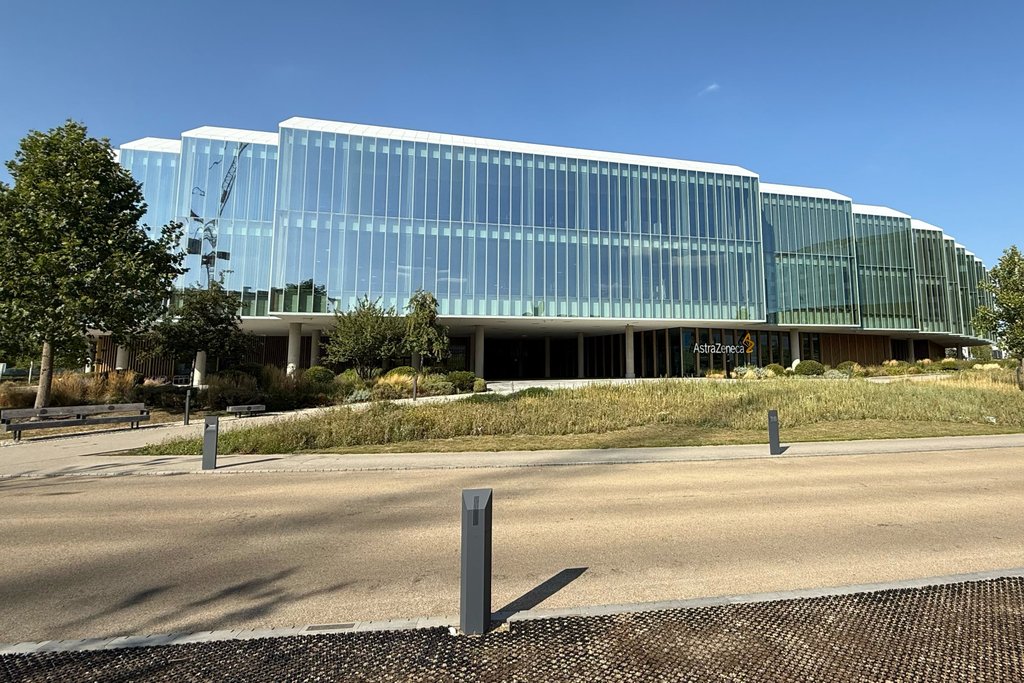
AstraZeneca's global headquarters are located in the Cambridge Biomedical Campus adjacent to Addenbrooke's Hospital in Cambridge, England. The facility, known as the Discovery Centre, was designed by Swiss architecture firm Herzog & de Meuron and officially opened by Prince Charles on the 23 November 2021. The building is designed to accommodate over 2,200 scientists across 16 laboratories covering approximately 19,000 square metres (200,000 sq ft). It was built at a cost of approximately £1 billion.
In September 2025, the Discovery Centre was shortlisted for the Stirling Prize.
Cambridge-Gothenburg flights
In 2015, AstraZeneca arranged for the establishment of a direct air route between Cambridge and Gothenburg, which began operation on 2 March 2015. The company reserved 20 of the 32 seats on each flight, with the remaining seats available to the public, which was operated by SUN-AIR for British Airways. The service connects AstraZeneca’s global headquarters in Cambridge with its research facility in Gothenburg. The service operated four days per week and was intended to support collaboration between staff in the two locations, allowing same-day travel for meetings. The route ended as a scheduled public service in 2016 due to insufficient demand, but these flights continue for AstraZeneca employees as of 2024.
Orphan drugs
In April 2015, AstraZeneca's drug tremelimumab was approved as an orphan drug for the treatment of mesothelioma in the United States. In February 2016, AstraZeneca announced that a clinical trial of tremelimumab as a treatment for mesothelioma failed to meet its primary endpoint.
Senior management
As of 2008, David Brennan was paid US$1,574,144 for his role as chief executive officer.
On 26 April 2012, it was announced that Brennan was to retire in early June of that year. In August 2012, Pascal Soriot was named CEO of AstraZeneca.
It was also announced that Leif Johansson would succeed Louis Schweitzer as non-executive chairman on 1 June 2012, three months earlier than previously announced, and would become Chairman of the Nomination and Governance Committee after the 2012 Annual General Meeting.
The company's non-executive Board directors are Philip Broadley, Euan Ashley, Michel Demaré, Deborah DiSanzo, Diana Layfield, Sheri McCoy, Tony Mok, Nazneen Rahman, Andreas Rummelt, and Marcus Wallenberg.
Lobbying
Political lobbying
AstraZeneca is a member of the Personalized Medicine Coalition, a medical research advocacy group that lobbies on behalf of the pharmaceutical industry.
Contentious treatments and related matters
Seroquel
In April 2010, AstraZeneca settled a qui tam lawsuit brought by Stefan P. Kruszewski for US$520 million to settle allegations that the company defrauded Medicare, Medicaid, and other government-funded health care programs in connection with its marketing and promotional practices for the blockbuster atypical antipsychotic, Seroquel. According to the settlement agreement, AstraZeneca targeted its illegal marketing of the anti-psychotic Seroquel towards doctors who do not typically treat schizophrenia or bipolar disorder, such as physicians who treat the elderly, primary care physicians, pediatric and adolescent physicians, and in long-term care facilities and prisons.
In March 2011, AstraZeneca settled a lawsuit in the United States totalling US$68.5 million to be divided up to 38 states.
Nexium
The company's most commercially successful medication is esomeprazole (Nexium). The primary uses are treatment of gastroesophageal reflux disease, treatment and maintenance of erosive esophagitis, treatment of duodenal ulcers caused by Helicobacter pylori, prevention of gastric ulcers in those on chronic NSAID therapy, and treatment of gastrointestinal ulcers associated with Crohn's disease. When it is manufactured the result is a mixture of two mirror-imaged molecules, R and S. Two years before the omeprazole patent expired, AstraZeneca patented S-omeprazole in pure form, pointing out that since some people metabolise R-omeprazole slowly, pure S-omeprazole treatment would give higher dose efficiency and less variation between individuals. In March 2001, the company began to market Nexium, as it would a brand new drug.
The (R)-enantiomer of omeprazole is metabolized exclusively by the enzyme CYP2C19, which is expressed in very low amounts by 3% of the population. Treated with a normal dose of the enantiomeric mixture, these persons will experience blood levels five-times higher than those with normal CYP2C19 production. In contrast, esomeprazole is metabolized by both CYP2C19 and CYP3A4, providing less-variable drug exposure. While omeprazole is approved only at doses of up to 20 mg for the treatment of gastroesophageal reflux, esomeprazole is approved for doses up to 40 mg.
In 2007, Marcia Angell, former editor-in-chief of the New England Journal of Medicine and a lecturer in social medicine at the Harvard Medical School, said in Stern, a German-language weekly newsmagazine, that AstraZeneca's scientists had misrepresented their research on the drug's efficiency, saying: "Instead of using presumably comparable doses [of each drug], the company's scientists used Nexium in higher dosages. They compared 20 and 40 mg Nexium with 20 mg Prilosec. With the cards having been marked in that way, Nexium looked like an improvement – which however was only small and shown in only two of the three studies."
Bildman fraud, sexual harassment and faithless servant clawback
On 4 February 1998, Astra USA sued Lars Bildman, its former president and chief executive officer, seeking US$15 million for defrauding the company. The sum included US$2.3 million in company funds he allegedly used to fix up three of his homes, plus money the company paid as the result of the EEOC investigation. Astra's lawsuit alleged Bildman sexually harassed and intimidated employees, used company funds for yachts and sex workers, destroyed documents and records, and concocted: "tales of conspiracy involving ex-KGB agents and competitors. This was in a last-ditch effort to distract attention from the real wrongdoer, Bildman himself." Bildman had already pleaded guilty in US District Court for failing to report more than US$1 million in income on his tax returns. In addition, several female co-workers filed personal sexual-harassment lawsuits against Bildman. In April 1998, Bildman was sentenced to 21 months in prison three months after he pled guilty to filing false Federal tax returns.
In February 1998, AstraZenaca's U.S. affiliate Astra U.S.A. agreed to a $10 million settlement after an Equal Employment Opportunity Commission investigation which started in May 1996 found that sexual harassment against female employees. 120 former female employees of Astra were interviewed during the inquiry, with about 80 of them being identified as able to file claims. Astra U.S.A. also issued a statement of apology for the hostile work environment.
In Astra USA v. Bildman, 914 N.E.2d 36 (Mass. 2009), applying New York's faithless servant doctrine, the court held that a company's employee who had engaged in financial misdeeds and sexual harassment must "forfeit all of his salary and bonuses for the period of disloyalty". The court held that this was the case even if the employee "otherwise performed valuable services", and that the employee was not entitled to recover restitution for the value of those other services. The decision attracted a good deal of attention by legal commentators.
CAFÉ study
In 2004, University of Minnesota research participant Dan Markingson took his own life while enrolled in an industry-sponsored pharmaceutical trial comparing three FDA-approved atypical antipsychotics: Seroquel (quetiapine), Zyprexa (olanzapine), and Risperdal (risperidone). University of Minnesota Professor of Bioethics Carl Elliott noted that Markingson was enrolled in the study against the wishes of his mother, Mary Weiss, and that he was forced to choose between enrolling in the study or being involuntarily committed to a state mental institution. A 2005 FDA investigation cleared the university. Nonetheless, controversy around the case has continued after a Mother Jones article was published.
Transfer mispricing
In February 2010, AstraZeneca agreed to pay £505 million to settle a UK tax dispute related to transfer mispricing.
Conflicting commitments to the UK and the EU over COVID-19 vaccines
In August 2020, AstraZeneca made an advance purchase agreement with the European Commission and the EU member states for the supply of COVID-19 vaccines:
"13.1. AstraZeneca represents, warrants and covenants to the Commission and the Participating Member States that: [...] (e) it is not under any obligation, contractual or otherwise, to any Person or third party in respect of the Initial Europe Doses or that conflicts with or is inconsistent in any material respect with the terms of this Agreement or would impede the complete fulfilment of its obligation under this Agreement;"
However, the UK Secretary of State for Health and Social Care, Matt Hancock, declared in March 2021 that the United Kingdom had been given "exclusivity" and that the EU's treaty was "inferior". After placing the order for AstraZeneca's vaccine, the European Commission mistakenly assumed that it had enough vaccines and initially ordered only 200 million doses from Pfizer–BioNTech when the manufacturers offered 500 million doses to the EU in November 2020.
However, the contract that AstraZeneca reached with the UK was very similar to that it reached with the EU, and it also contained the phrase "best reasonable efforts"; the UK contract was signed on 28 August 2020, a day after the contract with the EU. The key difference seems to be that AstraZeneca entered into a preliminary agreement with the U.K. back in May 2020 which arranged for "the development of a dedicated supply chain for the U.K." The failure to produce the vaccine in the anticipated quantities contributed to the low vaccination rates of vulnerable populations of the European Union at the beginning of the outbreak of more virulent variants of SARS-CoV-2 in early 2021.
Operations in China and investigation
AstraZeneca's reputation in China was tarnished when its Chinese subsidiary did not quickly donate to relief efforts after the 2008 Sichuan earthquake. Typically, donations for disaster relief in China are made through funds established through the Chinese Ministry of Civil Affairs and its subordinate organization, the Red Cross Society of China. AstraZeneca had a corporate rule prohibiting foreign subsidiaries from making donations to local governments, and the company construed this rule as prohibiting donations for Sichuan earthquake relief efforts. AstraZeneca's Chinese subsidiary suffered a major backlash for its failure to donate. Corporate approval was eventually given for the Chinese subsidiary to donate, but only after a long delay.
During the early 2020s, AstraZeneca expanded its R&D pipeline within China, increasing its investment in the country; the firm also signed licensing agreements with nine separate biotech firms in China that have been collectively valued at $6.5 billion.
In May 2023, AstraZeneca's China president, Leon Wang, stated that the company aimed to be a "patriotic" company in China that "loves the Communist Party." On 30 October 2024, AstraZeneca said that Wang was under investigation by Chinese authorities and had been detained. The China business is now being run by Michael Lai, the general manager.
In November 2024, it was announced that Chinese officials had widened their investigation under a national anti-corruption campaign targeting healthcare. Among the allegations, former AstraZeneca employees are accused of falsifying genetic tests to secure reimbursement for the company’s lung cancer drug, Tagrisso. Several current and former company executives are also being investigated for potentially breaching data privacy laws and for the suspected illegal importation of certain cancer drugs – likely including Enhertu, Imfinzi and Imjudo – from Hong Kong.
Operations in Russia
Following Russia's invasion of Ukraine in 2022, AstraZeneca faced criticism for maintaining its operations and continuing certain clinical trials in Russia, despite promising to halt new investments in the country. While several international pharmaceutical companies announced suspensions of new clinical studies in Russia after the conflict began, AstraZeneca moved forward with a study for a new COVID-19 prevention drug, essential for its registration in Russia.
Source: Wikipedia, CC BY-SA 4.0 · View on Wikipedia ↗
10-Year Performance Revenue, net income, margins and EPS trends
Valuation P/E, P/S, P/B, EV/EBITDA ratios — is the stock expensive or cheap?
| Metric | 5Y trend | AZN | 5Y avg | Peer Median | Verdict |
|---|---|---|---|---|---|
| P/E | 28.15Y avg ≈322.6 | ≈322.6 | · | · |
Peer median is calculated on a standardized basis per metric and may not always match the TTM/MRQ basis shown for this stock.
Profitability Gross, operating and net margins; ROE, ROA, ROIC
| Metric | 5Y trend | AZN | 5Y avg | Peer Median | Verdict |
|---|---|---|---|---|---|
| Gross Margin | 81.9%5Y avg ≈76.8% | ≈76.8% | · | · | |
| Operating Margin | 23.4%5Y avg ≈14.2% | ≈14.2% | · | · | |
| EBITDA Margin | 23.4%5Y avg ≈14.2% | ≈14.2% | · | · | |
| Pretax Margin | 21.1%5Y avg ≈11.4% | ≈11.4% | · | · | |
| Net Profit Margin | 17.4%5Y avg ≈10.2% | ≈10.2% | · | · | |
| ROA | 9.4%5Y avg ≈5.1% | ≈5.1% | · | · | |
| ROE | 22.9%5Y avg ≈13.0% | ≈13.0% | · | · | |
| ROIC | 23.3%5Y avg ≈14.7% | ≈14.7% | · | · |
Financial Health Debt, liquidity, solvency — balance sheet strength
| Metric | 5Y trend | AZN | 5Y avg | Peer Median | Verdict |
|---|---|---|---|---|---|
| Current Ratio | 0.95Y avg ≈0.9 | ≈0.9 | · | · | |
| Quick Ratio | 0.55Y avg ≈0.5 | ≈0.5 | · | · | |
| Interest Coverage | 8.15Y avg ≈4.5 | ≈4.5 | · | · |
Growth Revenue, EPS and net income growth: YoY, 3Y CAGR, 5Y CAGR
Not enough fundamentals data to compute this ratio group yet.
Capital Efficiency Asset turnover, inventory turnover, receivables turnover
| Metric | 5Y trend | AZN | 5Y avg | Peer Median | Verdict |
|---|---|---|---|---|---|
| Asset Turnover | 0.55Y avg ≈0.5 | ≈0.5 | · | · | |
| Inventory Turnover | 1.85Y avg ≈1.8 | ≈1.8 | · | · | |
| Receivables Turnover | 4.25Y avg ≈4.3 | ≈4.3 | · | · | |
| Revenue / Employee | ≈$611.2K | · | · | · |
value · ≈ 5Y avg · industry median · verdict relative to median
Dividends Yield, payout ratio, dividend history, 5Y CAGR
| Ex-date | Amount | Currency | Yield |
|---|---|---|---|
| Feb 19, 2026 | $2.15 | USD | ≈1.5% |
| Aug 8, 2025 | $1.03 | USD | ≈2.1% |
| Feb 21, 2025 | $2.10 | USD | ≈2.1% |
| Aug 9, 2024 | $1.00 | USD | ≈1.8% |
| Feb 22, 2024 | $1.97 | USD | ≈2.3% |
| Aug 10, 2023 | $0.93 | USD | ≈2.1% |
| Feb 23, 2023 | $1.97 | USD | ≈2.2% |
| Aug 11, 2022 | $0.93 | USD | ≈2.2% |
| Feb 24, 2022 | $1.97 | USD | ≈2.5% |
| Aug 12, 2021 | $0.90 | USD | ≈2.4% |
| Feb 25, 2021 | $1.90 | USD | ≈2.9% |
| Aug 13, 2020 | $0.90 | USD | ≈2.5% |
| Feb 27, 2020 | $1.90 | USD | ≈3.1% |
| Aug 8, 2019 | $0.90 | USD | ≈3.2% |
| Feb 28, 2019 | $1.90 | USD | ≈3.4% |
| Aug 9, 2018 | $0.90 | USD | ≈3.5% |
| Feb 15, 2018 | $1.90 | USD | ≈4.1% |
| Aug 9, 2017 | $0.90 | USD | ≈4.8% |
| Feb 15, 2017 | $1.90 | USD | ≈4.9% |
| Aug 10, 2016 | $0.90 | USD | ≈4.2% |
Earnings History EPS actual vs estimate, surprise %, beat rate, next earnings date
| Period | Report | EPS Actual | EPS Est | Surprise |
|---|---|---|---|---|
| June 30, 2026 | $2.63 | $2.55 | 3.1% | |
| March 31, 2026 | $2.58 | $2.59 | -0.47% | |
| Dec. 31, 2025 | $2.12 | $2.15 | -1.5% | |
| Sept. 30, 2025 | $2.38 | $2.35 | 1.5% | |
| June 30, 2025 | $2.17 | $2.21 | -1.7% | |
| March 31, 2025 | $2.12 | $2.15 | -1.5% |
Full Fundamentals All metrics by year — income statement, balance sheet, cash flow
Income Statement
| Metric | Trend | 2025 | 2024 | 2023 | 2022 | 2021 | 2020 | 2019 | 2018 | 2017 | 2016 | 2015 |
|---|---|---|---|---|---|---|---|---|---|---|---|---|
| Revenue | $58.74B | $54.07B | $45.81B | $44.35B | $37.42B | $26.62B | $24.38B | $22.09B | $22.46B | $23.00B | $24.71B | |
| Cost of Revenue | $10.63B | $10.21B | $8.27B | $12.39B | $12.44B | $5.30B | $4.92B | $4.94B | $4.32B | $4.13B | $4.65B | |
| Gross Profit | $48.11B | $43.87B | $37.54B | $31.96B | $24.98B | $21.32B | $19.46B | $17.15B | $18.15B | $18.88B | $20.06B | |
| R&D Expense | $14.23B | $13.58B | $10.94B | $9.76B | $9.74B | $5.99B | $6.06B | $5.93B | $5.76B | $5.89B | $6.00B | |
| SG&A Expense | $19.93B | $19.98B | $19.22B | $18.42B | $15.23B | $11.29B | $11.68B | $10.03B | $10.23B | $9.41B | $11.11B | |
| Operating Income | $13.74B | $10.00B | $8.19B | $3.76B | $1.06B | $5.16B | $2.92B | $3.39B | $3.68B | $4.90B | $4.11B | |
| Interest Expense | $1.69B | $1.74B | $1.63B | $1.35B | $1.30B | $1.31B | $1.43B | $1.42B | $1.51B | $1.38B | $1.07B | |
| Interest Income | $360M | $458M | $344M | $95M | $43M | $87M | $172M | $138M | $113M | $67M | $46M | |
| Pretax Income | $12.40B | $8.69B | $6.90B | $2.50B | $-265M | $3.92B | $1.55B | $1.99B | $2.23B | $3.55B | $3.07B | |
| Income Tax | $2.17B | $1.65B | $938M | $-792M | $-380M | $772M | $321M | $-57M | $-641M | $146M | $243M | |
| Net Income | $10.22B | $7.04B | $5.96B | $3.29B | $112M | $3.20B | $1.33B | $2.15B | $3.00B | $3.50B | $2.83B | |
| EPS (Basic) | $6.60 | $4.54 | $3.84 | $2.12 | $0.08 | $2.44 | $1.03 | $1.70 | $2.37 | $2.77 | $2.23 | |
| EPS (Diluted) | $6.54 | $4.50 | $3.81 | $2.11 | $0.08 | $2.44 | $1.03 | $1.70 | $2.37 | $2.76 | $2.23 | |
| Shares (Basic) | 1,550,000,000 | 1,550,000,000 | 1,549,000,000 | 1,548,000,000 | 1,418,000,000 | 1,312,000,000 | 1,301,000,000 | 1,267,000,000 | 1,266,000,000 | 1,265,000,000 | 1,264,000,000 | |
| Shares (Diluted) | 1,562,000,000 | 1,563,000,000 | 1,562,000,000 | 1,560,000,000 | 1,427,000,000 | 1,313,000,000 | 1,301,000,000 | 1,267,000,000 | 1,267,000,000 | 1,266,000,000 | 1,265,000,000 | |
| EBITDA | $13.74B | $10.00B | $8.19B | $3.76B | $1.06B | $5.16B | $2.92B | $3.39B | $3.68B | · | · |
Balance Sheet
| Metric | Trend | 2025 | 2024 | 2023 | 2022 | 2021 | 2020 | 2019 | 2018 | 2017 | 2016 | 2015 |
|---|---|---|---|---|---|---|---|---|---|---|---|---|
| Cash & Equivalents | $1.33B | $1.22B | $1.32B | $1.41B | $1.46B | $1.18B | $755M | $893M | $784M | $782M | $1.25B | |
| Receivables | $15.18B | $12.97B | $12.13B | $10.52B | $9.64B | $7.02B | $5.76B | $5.57B | $5.01B | $4.57B | $6.62B | |
| Inventory | $6.56B | $5.29B | $5.42B | $4.70B | $8.98B | $4.02B | $3.19B | $2.89B | $3.04B | $2.33B | $2.14B | |
| Current Assets | $28.72B | $25.83B | $25.05B | $22.59B | $26.24B | $19.54B | $15.56B | $15.59B | $13.15B | $13.26B | $16.01B | |
| PP&E (Net) | $12.96B | $10.25B | $9.40B | $8.51B | $9.18B | $8.25B | $7.69B | $7.42B | $7.62B | $6.85B | $6.41B | |
| Goodwill | $21.24B | $21.02B | $20.05B | $19.82B | $20.00B | $11.85B | $11.67B | $11.71B | $11.82B | $11.66B | $11.80B | |
| Intangibles | $37.85B | $37.18B | $38.09B | $39.31B | $42.49B | $20.95B | $20.83B | $21.96B | $26.19B | $27.59B | $22.65B | |
| Total Assets | $114.07B | $104.03B | $101.12B | $96.48B | $105.36B | $66.73B | $61.38B | $60.65B | $63.35B | $62.53B | $60.06B | |
| Accounts Payable | $25.28B | $22.46B | $22.37B | $19.04B | $18.94B | $15.79B | $13.99B | $12.84B | $11.64B | $10.49B | $11.66B | |
| Current Liabilities | $30.62B | $27.87B | $30.54B | $26.29B | $22.59B | $20.31B | $18.12B | $16.29B | $16.38B | $15.26B | $14.87B | |
| Total Liabilities | $65.36B | $63.16B | $61.95B | $59.42B | $66.08B | $51.09B | $46.78B | $46.61B | $46.71B | $45.86B | $41.55B | |
| Retained Earnings | $10.97B | $3.16B | $1.50B | $-574M | $1.71B | $5.30B | $2.81B | $5.68B | $8.22B | $8.14B | $11.83B | |
| Stockholders' Equity | $48.67B | $40.79B | $39.14B | $37.04B | $39.27B | $15.62B | $13.13B | $12.47B | $14.96B | $14.85B | $18.49B |
Cash Flow
| Metric | Trend | 2025 | 2024 | 2023 | 2022 | 2021 | 2020 | 2019 | 2018 | 2017 | 2016 | 2015 |
|---|---|---|---|---|---|---|---|---|---|---|---|---|
| Operating Cash Flow | $14.57B | $11.86B | $10.35B | $9.81B | $5.96B | $4.80B | $2.97B | $2.62B | $3.58B | $4.14B | $3.32B | |
| CapEx | $2.81B | $1.92B | $1.36B | $1.09B | $1.09B | $961M | $979M | $1.04B | $1.33B | $1.45B | $1.33B | |
| Investing Cash Flow | $-6.81B | $-7.98B | $-4.06B | $-2.96B | $-11.06B | $-285M | $-657M | $963M | $-2.33B | $-3.97B | $-4.24B | |
| Dividends Paid | $4.97B | $4.63B | $4.48B | $4.36B | $3.86B | $3.57B | $3.59B | $3.48B | $3.52B | $3.56B | $3.49B | |
| Financing Cash Flow | $-7.54B | $-4.00B | $-6.57B | $-6.82B | $3.65B | $-2.20B | $-1.76B | $-2.04B | $-2.94B | $-1.32B | $878M | |
| Free Cash Flow | $11.77B | $9.94B | $8.98B | $8.72B | $4.87B | $3.84B | $1.99B | $1.57B | $2.25B | · | · | |
| Levered FCF | $10.37B | $8.53B | $7.58B | $6.94B | $5.44B | $2.79B | $855M | $115M | $310M | · | · |
Profitability
| Metric | Trend | 2025 | 2024 | 2023 | 2022 | 2021 | 2020 | 2019 | 2018 | 2017 | 2016 | 2015 |
|---|---|---|---|---|---|---|---|---|---|---|---|---|
| Gross Margin | 81.9% | 81.1% | 82.0% | 72.1% | 66.8% | 80.1% | 79.8% | 77.7% | 80.8% | · | · | |
| Operating Margin | 23.4% | 18.5% | 17.9% | 8.5% | 2.8% | 19.4% | 12.0% | 15.3% | 16.4% | · | · | |
| Net Margin | 17.4% | 13.0% | 13.0% | 7.4% | 0.30% | 12.0% | 5.5% | 9.8% | 13.4% | · | · | |
| Pretax Margin | 21.1% | 16.1% | 15.1% | 5.6% | -0.71% | 14.7% | 6.3% | 9.0% | 9.9% | · | · | |
| EBITDA Margin | 23.4% | 18.5% | 17.9% | 8.5% | 2.8% | 19.4% | 12.0% | 15.3% | 16.4% | · | · | |
| ROA | 9.4% | 6.9% | 6.0% | 3.3% | 0.13% | 5.0% | 2.2% | 3.5% | 4.8% | · | · | |
| ROE | 22.9% | 17.6% | 15.6% | 8.6% | 0.41% | 22.2% | 10.4% | 15.7% | 20.1% | · | · | |
| ROIC | 23.3% | 19.9% | 18.1% | 13.4% | -1.2% | 26.5% | 17.7% | 27.9% | 31.6% | · | · |
Liquidity & Solvency
| Metric | Trend | 2025 | 2024 | 2023 | 2022 | 2021 | 2020 | 2019 | 2018 | 2017 | 2016 | 2015 |
|---|---|---|---|---|---|---|---|---|---|---|---|---|
| Current Ratio | 0.9 | 0.9 | 0.8 | 0.9 | 1.2 | 1.0 | 0.9 | 1.0 | 0.8 | · | · | |
| Quick Ratio | 0.5 | 0.5 | 0.4 | 0.5 | 0.5 | 0.4 | 0.4 | 0.4 | 0.4 | · | · | |
| Interest Coverage | 8.1 | 5.7 | 5.0 | 2.8 | 0.8 | 4.0 | 2.0 | 2.4 | 2.4 | · | · |
Efficiency
| Metric | Trend | 2025 | 2024 | 2023 | 2022 | 2021 | 2020 | 2019 | 2018 | 2017 | 2016 | 2015 |
|---|---|---|---|---|---|---|---|---|---|---|---|---|
| Asset Turnover | 0.5 | 0.5 | 0.5 | 0.4 | 0.4 | 0.4 | 0.4 | 0.4 | 0.4 | · | · | |
| Inventory Turnover | 1.8 | 1.9 | 1.6 | 1.8 | 1.9 | 1.5 | 1.6 | 1.7 | 1.6 | · | · | |
| Receivables Turnover | 4.2 | 4.3 | 4.0 | 4.4 | 4.5 | 4.2 | 4.3 | 4.2 | 4.7 | · | · |
Per Share
| Metric | Trend | 2025 | 2024 | 2023 | 2022 | 2021 | 2020 | 2019 | 2018 | 2017 | 2016 | 2015 |
|---|---|---|---|---|---|---|---|---|---|---|---|---|
| Revenue / Share | $37.60 | $34.60 | $29.33 | $28.43 | $26.22 | $20.27 | $18.74 | $17.43 | $17.73 | · | · | |
| Cash Flow / Share | $9.33 | $7.59 | $6.62 | $6.29 | $4.18 | $3.65 | $2.28 | $2.07 | $2.82 | · | · | |
| Dividend / Share | $3.13 | $2.97 | $2.90 | $2.90 | $2.80 | $2.80 | · | · | · | · | · | |
| EPS (TTM) | $6.54 | $4.50 | $3.81 | $2.11 | $0.08 | $2.44 | $1.03 | $1.70 | $2.37 | · | · |
Valuation (TTM)
| Metric | Trend | 2025 | 2024 | 2023 | 2022 | 2021 | 2020 | 2019 | 2018 | 2017 | 2016 | 2015 |
|---|---|---|---|---|---|---|---|---|---|---|---|---|
| Revenue TTM | $58.74B | $54.07B | $45.81B | $44.35B | $37.42B | $26.62B | $24.38B | $22.09B | $22.46B | · | · | |
| Net Income TTM | $10.22B | $7.04B | $5.96B | $3.29B | $112M | $3.20B | $1.33B | $2.15B | $3.00B | · | · | |
| P/E | 28.1 | 29.1 | 35.4 | 64.3 | 1456.2 | 41.0 | 96.8 | 44.7 | 29.3 | · | · | |
| Earnings Yield | 3.6% | 3.4% | 2.8% | 1.6% | 0.07% | 2.4% | 1.0% | 2.2% | 3.4% | · | · | |
| Payout Ratio | 48.6% | 65.8% | 75.2% | 132.7% | 3442.9% | 111.8% | 269.1% | 161.7% | 117.3% | · | · | |
| Annual Payout | $4.97B | $4.63B | $4.48B | $4.36B | $3.86B | $3.57B | $3.59B | $3.48B | $3.52B | · | · |
Per Share
| Metric | Trend | Q4 2016 | Q4 2015 | Q4 2014 | Q4 2013 | Q4 2012 | Q4 2011 | Q4 2010 | Q4 2009 | Q4 2008 | Q4 2007 | Q4 2006 | Q4 2005 | Q4 2004 | Q4 2003 | Q4 2002 |
|---|---|---|---|---|---|---|---|---|---|---|---|---|---|---|---|---|
| EPS (TTM) | $2.76 | $2.23 | · | · | · | · | · | · | · | · | · | · | · | · | · |
Valuation (TTM)
| Metric | Trend | Q4 2016 | Q4 2015 | Q4 2014 | Q4 2013 | Q4 2012 | Q4 2011 | Q4 2010 | Q4 2009 | Q4 2008 | Q4 2007 | Q4 2006 | Q4 2005 | Q4 2004 | Q4 2003 | Q4 2002 |
|---|---|---|---|---|---|---|---|---|---|---|---|---|---|---|---|---|
| Revenue TTM | $23.00B | $24.71B | · | · | · | · | · | · | · | · | · | · | · | · | · | |
| Net Income TTM | $3.50B | $2.83B | · | · | · | · | · | · | · | · | · | · | · | · | · | |
| P/E | 19.8 | 30.4 | · | · | · | · | · | · | · | · | · | · | · | · | · | |
| Earnings Yield | 5.1% | 3.3% | · | · | · | · | · | · | · | · | · | · | · | · | · | |
| Annual Payout | $3.56B | $3.49B | · | · | · | · | · | · | · | · | · | · | · | · | · |
Most recent period on the left · null values shown as ·
Financial Statements Income statement, balance sheet, cash flow — annual, last 5 years
| Metric | 2025-12-31 | 2024-12-31 | 2023-12-31 | 2022-12-31 | 2021-12-31 |
|---|---|---|---|---|---|
| Revenue | $58.74B | $54.07B | $45.81B | $44.35B | $37.42B |
| Gross Margin % | 81.9% | 81.1% | 82.0% | 72.1% | 66.8% |
| Operating Margin % | 23.4% | 18.5% | 17.9% | 8.5% | 2.8% |
| Net Income | $10.22B | $7.04B | $5.96B | $3.29B | $112M |
| Diluted EPS | $6.54 | $4.50 | $3.81 | $2.11 | $0.08 |
| Metric | 2025-12-31 | 2024-12-31 | 2023-12-31 | 2022-12-31 | 2021-12-31 |
|---|---|---|---|---|---|
| Current Ratio | 0.9 | 0.9 | 0.8 | 0.9 | 1.2 |
| Quick Ratio | 0.5 | 0.5 | 0.4 | 0.5 | 0.5 |
| Metric | 2025-12-31 | 2024-12-31 | 2023-12-31 | 2022-12-31 | 2021-12-31 |
|---|---|---|---|---|---|
| Free Cash Flow | $11.77B | $9.94B | $8.98B | $8.72B | $4.87B |
Institutional owners (13F) 1,603 filers · $151.6B total · As of Sept. 30, 2026
Institutions that report holding this stock in their quarterly SEC Form 13F. Long positions only; a single filer may appear twice for separate option legs. Large offsetting put/call legs typically reflect market-making or hedged inventory, not directional conviction.
| New positions | Exited positions | Increased | Decreased | Net shares change |
|---|---|---|---|---|
| 277 | 122 | 526 | 482 | · |
Compared to Q1 2026. SEC Form 13F filings are due within 45 days of quarter-end plus a short buffer for late filers — quarters still inside that window are skipped in favor of the most recent fully-reported pair. Change vs prior quarter not shown: filer coverage differs too much between these two quarters for a reliable comparison.
| Institution | Value | Shares | % of tracked 13F | Type |
|---|---|---|---|---|
| INVESTOR AB | $9,782,080,532 | 51,587,810 | 6.45% | Shares |
| VANGUARD CAPITAL MANAGEMENT LLC | $8,473,783,218 | 45,386,190 | 5.59% | Shares |
| Capital International Investors | $6,491,696,089 | 34,576,070 | 4.28% | Shares |
| NORGES BANK | $6,334,634,620 | 33,864,172 | 4.18% | Shares |
| Capital World Investors | $5,628,675,304 | 30,075,134 | 3.71% | Shares |
| FMR LLC | $5,418,247,516 | 28,895,264 | 3.57% | Shares |
| WELLINGTON MANAGEMENT GROUP LLP | $5,363,367,781 | 28,537,243 | 3.54% | Shares |
| Legal & General Group Plc | $4,818,951,521 | 25,750,245 | 3.18% | Shares |
| JPMORGAN CHASE & CO | $3,667,161,565 | 19,204,823 | 2.42% | Shares |
| VANGUARD ASSET MANAGEMENT, Ltd | $3,493,777,016 | 18,712,920 | 2.31% | Shares |
| PRIMECAP MANAGEMENT CO/CA/ | $3,431,207,652 | 18,095,178 | 2.26% | Shares |
| BANK OF AMERICA CORP /DE/ | $3,354,465,405 | 17,690,462 | 2.21% | Shares |
| PRUDENTIAL PLC | $3,189,396,568 | 170,573 | 2.10% | Shares |
| Amundi | $3,114,088,303 | 16,422,784 | 2.05% | Shares |
| FRANKLIN RESOURCES INC | $3,112,856,747 | 16,511,727 | 2.05% | Shares |
| VANGUARD FIDUCIARY TRUST CO | $2,481,498,734 | 13,291,085 | 1.64% | Shares |
| DEUTSCHE BANK AG\ | $2,396,924,225 | 12,640,672 | 1.58% | Shares |
| JANUS HENDERSON GROUP PLC | $2,319,946,731 | 11,949,424 | 1.53% | Shares |
| DZ BANK AG Deutsche Zentral Genossenschafts Bank, Frankfurt am Main | $2,193,836,685 | 11,720,479 | 1.45% | Shares |
| Fisher Asset Management, LLC | $2,113,559,984 | 11,146,292 | 1.39% | Shares |
| AVIVA PLC | $2,037,421,320 | 10,899,700 | 1.34% | Shares |
| ROYAL BANK OF CANADA | $1,977,261,000 | 10,427,503 | 1.30% | Shares |
| Invesco Ltd. | $1,929,765,178 | 10,177,013 | 1.27% | Shares |
| ROYAL LONDON ASSET MANAGEMENT LTD | $1,926,733,750 | 10,161,026 | 1.27% | Shares |
| GOLDMAN SACHS GROUP INC | $1,847,353,286 | 9,742,396 | 1.22% | Shares |
| CAUSEWAY CAPITAL MANAGEMENT LLC | $1,751,546,442 | 9,357,390 | 1.16% | Shares |
| Rathbones Group PLC | $1,493,232,144 | 7,979,150 | 0.99% | Shares |
| MORGAN STANLEY | $1,490,282,149 | 7,859,306 | 0.98% | Shares |
| BNP PARIBAS ASSET MANAGEMENT Holding S.A. | $1,409,140,375 | 7,536,227 | 0.93% | Shares |
| Nuveen, LLC | $1,345,621,790 | 7,183,115 | 0.89% | Shares |
| Sanders Capital, LLC | $1,324,842,705 | 6,986,830 | 0.87% | Shares |
| Bank of New York Mellon Corp | $1,280,686,236 | 6,753,962 | 0.84% | Shares |
| Allianz Asset Management GmbH | $1,252,043,956 | 6,690,300 | 0.83% | Shares |
| BARCLAYS PLC | $1,250,051,459 | 6,592,403 | 0.82% | Shares |
| AMERIPRISE FINANCIAL INC | $1,153,543,231 | 6,095,430 | 0.76% | Shares |
| Swiss National Bank | $1,106,335,532 | 5,934,315 | 0.73% | Shares |
| SEB Asset Management AB | $1,077,346,851 | 5,736,648 | 0.71% | Shares |
| UBS Group AG | $1,004,504,745 | 5,297,462 | 0.66% | Shares |
| ARROWSTREET CAPITAL, LIMITED PARTNERSHIP | $1,002,488,229 | 5,307,020 | 0.66% | Shares |
| Clearbridge Investments, LLC | $952,180,240 | 5,021,518 | 0.63% | Shares |
| CAISSE DES DEPOTS ET CONSIGNATIONS | $942,096,200 | 5,034,088 | 0.62% | Shares |
| CITIGROUP INC | $916,202,232 | 4,895,753 | 0.60% | Shares |
| ALLIANCEBERNSTEIN L.P. | $857,007,480 | 4,345,439 | 0.57% | Shares |
| FIL Ltd | $840,251,010 | 4,492,612 | 0.55% | Shares |
| M&G PLC | $837,639,130 | 4,479,801 | 0.55% | Shares |
| Capital Research Global Investors | $787,343,259 | 4,197,587 | 0.52% | Shares |
| CREDIT AGRICOLE S A | $700,486,240 | 3,694,158 | 0.46% | Shares |
| MANUFACTURERS LIFE INSURANCE COMPANY, THE | $686,859,853 | 3,673,390 | 0.45% | Shares |
| CIBC Bancorp USA Inc. | $680,753,596 | 3,772,997 | 0.45% | Shares |
| CIBC Private Wealth Group LLC | $625,586,202 | 8,154,148 | 0.41% | Shares |
Activists & 5%+ owners 4 positions
Investors who filed SEC Schedule 13D — beneficial ownership above 5% with an intent to influence the issuer (activist stakes, board campaigns, M&A). Each row shows the most recent known state of that filer's position.
| Filer | Filed | Stake | Status | Purpose | Filing |
|---|---|---|---|---|---|
| AstraZeneca PLC, MedImmune Limited ×14 filings | Feb. 6, 2026 | 8.30% | Amendment | · | SEC |
| AstraZeneca Holdings B.V., AstraZeneca PLC ×2 filings | Nov. 16, 2023 | · | Initial filing | · | SEC |
| INVESTOR AB | Feb. 17, 2004 | · | Initial filing | · | SEC |
| Undisclosed reporting person | July 8, 2002 | · | Initial filing | Passive investment | SEC |
Purpose is an automated classification of the filer's own stated purpose (SEC Item 4) — not investment advice. "—" means no clear purpose was stated or the text could not be classified.
Company insiders 1 insider · 1 officers · 0 directors
| Insider | Role | Last activity | Shares owned | Buys 12m | Sells 12m | Net 12m |
|---|---|---|---|---|---|---|
| Mani Sharma | SVP, Group Controller and Head of Global Finance Services | Sept. 8, 2026 A | 19,289 | 1 | 1 | $-2,206,271 |
Insiders from SEC Form 3/4/5 filings; net = open-market P/S only
ETF ownership Held by 56 ETFs
Weight reflects direct equity holdings (N-PORT) only; leveraged or derivative-based funds may hold additional swap exposure not shown.
| Fund | Weight | Units | As of | Source |
|---|---|---|---|---|
| EWU · iShares Trust | 7.56% | 1,756,523 SH | Sept. 11, 2026 | Daily |
| IXJ · iShares Trust | 3.13% | 815,554 SH | Sept. 11, 2026 | Daily |
| GENW · Spinnaker ETF Series | 2.72% | 819 NS | July 31, 2026 | N-PORT |
| EFG · iShares Trust | 2.23% | 2,337,347 SH | Sept. 11, 2026 | Daily |
| TOUS · T. Rowe Price Exchange-Traded Funds… | 2.13% | 198,572 NS | July 31, 2026 | N-PORT |
| IDVZ · Elevation Series Trust | 1.81% | 20,959 NS | July 31, 2026 | N-PORT |
| VGK · VANGUARD INTERNATIONAL EQUITY INDEX… | 1.76% | 3,605,502 SH | Aug. 19, 2026 | Daily |
| IEV · iShares Trust | 1.75% | 180,885 SH | Sept. 11, 2026 | Daily |
| IQLT · iShares Trust | 1.57% | 1,375,224 SH | Sept. 11, 2026 | Daily |
| IEUR · iShares Trust | 1.53% | 879,575 SH | Sept. 11, 2026 | Daily |
| XT · iShares Trust | 1.39% | 339,444 SH | Sept. 11, 2026 | Daily |
| PABD · iShares Trust | 1.13% | 23,539 SH | Sept. 11, 2026 | Daily |
| EFA · iShares Trust | 1.09% | 5,389,193 SH | Sept. 11, 2026 | Daily |
| IMFL · Invesco Exchange-Traded Self-Indexe… | 1.00% | 68,721 SH | Oct. 5, 2026 | Daily |
| ESGD · iShares Trust | 0.95% | 727,432 SH | Sept. 11, 2026 | Daily |
| DIHP · Dimensional ETF Trust | 0.95% | 356,746 NS | July 31, 2026 | N-PORT |
| IEFA · iShares Trust | 0.93% | 11,395,330 SH | Sept. 11, 2026 | Daily |
| VEA · VANGUARD TAX-MANAGED FUNDS | 0.85% | 14,666,227 SH | Aug. 19, 2026 | Daily |
| MTRA · Invesco Actively Managed Exchange-T… | 0.85% | 7,346 SH | Oct. 5, 2026 | Daily |
| VSGX · VANGUARD WORLD FUND | 0.83% | 301,296 SH | Aug. 19, 2026 | Daily |
| IDEV · iShares Trust | 0.82% | 1,674,581 SH | Sept. 11, 2026 | Daily |
| AQLT · iShares Trust | 0.76% | 15,622 SH | Sept. 11, 2026 | Daily |
| INTF · iShares Trust | 0.76% | 179,386 SH | Sept. 11, 2026 | Daily |
| VEU · VANGUARD INTERNATIONAL EQUITY INDEX… | 0.68% | 3,510,568 SH | Aug. 19, 2026 | Daily |
| DFSI · Dimensional ETF Trust | 0.66% | 44,503 NS | July 31, 2026 | N-PORT |
| ACWX · iShares Trust | 0.63% | 498,749 SH | Sept. 11, 2026 | Daily |
| VXUS · VANGUARD STAR FUNDS | 0.62% | 22,045,590 SH | Aug. 19, 2026 | Daily |
| IOO · iShares Trust | 0.60% | 339,411 SH | Sept. 11, 2026 | Daily |
| EFAV · iShares Trust | 0.58% | 198,618 SH | Sept. 11, 2026 | Daily |
| IXUS · iShares Trust | 0.55% | 2,083,402 SH | Sept. 11, 2026 | Daily |
| BSCS · Invesco Exchange-Traded Self-Indexe… | 0.53% | 18,939,000 | Oct. 5, 2026 | Daily |
| BSCT · Invesco Exchange-Traded Self-Indexe… | 0.51% | 15,295,000 | Oct. 5, 2026 | Daily |
| PXF · Invesco Exchange-Traded Fund Trust … | 0.50% | 92,922 SH | Oct. 5, 2026 | Daily |
| BSCU · Invesco Exchange-Traded Self-Indexe… | 0.48% | 14,539,000 | Oct. 5, 2026 | Daily |
| BSCR · Invesco Exchange-Traded Self-Indexe… | 0.46% | 20,776,000 | Oct. 5, 2026 | Daily |
| DFIC · Dimensional ETF Trust | 0.33% | 291,092 NS | July 31, 2026 | N-PORT |
| TOK · iShares Trust | 0.28% | 4,218 SH | Sept. 11, 2026 | Daily |
| DXIV · Dimensional ETF Trust | 0.28% | 3,355 NS | July 31, 2026 | N-PORT |
| URTH · iShares, Inc. | 0.27% | 136,775 SH | Sept. 11, 2026 | Daily |
| VT · VANGUARD INTERNATIONAL EQUITY INDEX… | 0.24% | 1,253,688 SH | Aug. 19, 2026 | Daily |
| ACWI · iShares Trust | 0.23% | 481,382 SH | Sept. 11, 2026 | Daily |
| CRBN · iShares Trust | 0.23% | 16,646 SH | Sept. 11, 2026 | Daily |
| DFAX · Dimensional ETF Trust | 0.20% | 139,688 NS | July 31, 2026 | N-PORT |
| GLOF · iShares Trust | 0.11% | 1,356 SH | Sept. 11, 2026 | Daily |
| GTOS · Invesco Actively Managed Exchange-T… | 0.01% | 6,000 | Oct. 5, 2026 | Daily |
| GTO · Invesco Actively Managed Exchange-T… | 0.00% | 7,000 | Sept. 30, 2026 | Daily |
| BIV · VANGUARD BOND INDEX FUNDS | · | · | July 15, 2026 | Daily |
| BLV · VANGUARD BOND INDEX FUNDS | · | · | July 15, 2026 | Daily |
| BSV · VANGUARD BOND INDEX FUNDS | · | · | July 15, 2026 | Daily |
| BND · VANGUARD BOND INDEX FUNDS | · | · | July 15, 2026 | Daily |
| VCSH · VANGUARD SCOTTSDALE FUNDS | · | · | July 15, 2026 | Daily |
| VCIT · VANGUARD SCOTTSDALE FUNDS | · | · | July 15, 2026 | Daily |
| VCLT · VANGUARD SCOTTSDALE FUNDS | · | · | July 15, 2026 | Daily |
| VTC · VANGUARD SCOTTSDALE FUNDS | · | · | July 30, 2026 | Daily |
| BNDW · VANGUARD SCOTTSDALE FUNDS | · | · | July 30, 2026 | Daily |
| BNDX · VANGUARD CHARLOTTE FUNDS | · | · | July 15, 2026 | Daily |
AZN Analyst Consensus Bullish and bearish analyst opinions, 12-month price target, upside
12-Month Price Target
11 analysts · 2026-10-04Mean target $212.17 +33.8%
Latest News Recent headlines mentioning this company
AZN AI Analyst Panel — Bullish and Bearish Views 2026Q2 debate: Claude, Grok, Gemini, ChatGPT on the stock's prospects
AstraZeneca faces a tug-of-war between its high-potential oncology pipeline and a strained balance sheet. Claude and Gemini flagged the 0.88 current ratio as a critical liquidity risk that could force unfavorable financing if trials stumble. Conversely, Grok argued that strong profit margins provide the necessary cash to fuel growth, justifying a bullish outlook. The panel remains split on whether the company's 30.6 P/E valuation is a fair price for future innovation or a trap for investors.
Round 1 — Opening Takes
AstraZeneca's oncology pipeline is firing on all cylinders with fresh approvals, fueling profit growth that could accelerate into 2026Q2. The EU nod for Imfinzi in early gastric cancers on March 25 opens new revenue streams in a high-margin franchise. ROE has risen to 21.8%, proving they're squeezing more earnings from their equity base amid improving efficiency. Net margin expanded to 16.17%, a clear sign costs are under control as sales ramp. Guggenheim's PT hike to 16,000 GBp underscores hedge fund conviction in the story.
AstraZeneca's balance sheet vulnerabilities could cap upside if drug launches falter or macro headwinds hit pharma. Current ratio at 0.88 falls short of 1.0, signaling potential strain in meeting short-term bills without extra financing. Debt-to-equity holds at 71.11, leveraging up returns but exposing the firm to interest rate spikes or cash burn. P/E near 30.6x leaves scant margin for error on earnings misses. Weekly closes dipping from 74.76 highs to 71.13 reflect fading momentum.
AstraZeneca is firing on pipeline momentum while trading at a reasonable premium to the pharma peer set. The Imfinzi EU approval for early gastric cancer (March 2026) signals execution on oncology, their highest-margin franchise. EPS is up to 6.02 from 5.31 a year ago — that's 13% growth. Gross margin holds steady at 82%, which is fortress-level for a diversified pharma player. Guggenheim's price target lift to 16,000 GBp in mid-March suggests institutional conviction on the pipeline. My read: if the oncology portfolio keeps delivering approvals through 2026, the 30.6x P/E compresses as growth justifies the multiple.
The balance sheet is the real problem here. Debt-to-equity sits at 71%, which is high for a company that needs optionality for R&D bets and M&A. Current ratio of 0.88 means AZN has less than a dollar of liquid assets for every dollar of short-term obligations — that's tight. P/S of 4.96 is elevated even for pharma, and it's crept up from 4.36 just two quarters ago. My concern: if pipeline momentum stalls or a late-stage trial disappoints, the leverage becomes a liability. The stock has also drifted sideways since May despite the news flow — that's a warning flag on conviction.
AstraZeneca’s aggressive expansion into oncology is paying off, creating a robust pipeline that justifies its premium valuation. The recent EU approval for Imfinzi in gastric cancers highlights this momentum. The company is delivering a 21.8% ROE, which shows they are highly efficient at generating profit from the capital shareholders have invested. Furthermore, their gross margin sits at 81.9%. This indicates that for every dollar of medicine they sell, they keep over 80 cents before operating costs, proving they have immense pricing power in the global pharmaceutical market.
The company’s balance sheet is showing signs of strain that could limit its flexibility in an expensive R&D environment. A current ratio of 0.88 is my primary concern. This means the company currently has less than a dollar in liquid assets for every dollar of short-term debt, which is a tight spot for a firm needing massive cash injections for clinical trials. Additionally, the stock trades at a P/E of 30.6. This multiple suggests investors are paying a steep price for future growth that may not materialize if upcoming drug trials fail to deliver.
I think AZN has upside leverage from strong profitability and a durable earnings base. ROE TTM: 21.8%. That means AZN turns equity into profit efficiently, supporting shareholder returns. Net profit margin TTM: 16.17%. That shows AZN converts sales to profits at a healthy rate, backing steady cash flow for pipeline growth. EPS TTM: 6.02. That level provides a tangible earnings base to support a re-rating if Imfinzi and other assets gain traction.
I think AZN faces valuation and balance-sheet risks that could cap upside. P/E TTM: 30.65. That rich multiple leaves little room for error if growth slows. Debt/Equity: 71.11. That high leverage reduces financial flexibility and amplifies risk if margins retreat. Current ratio: 0.8792. That below-one liquidity signal can press AZN to tighten funding for R&D or pass through higher financing costs.
Round 2 — Responses & Rebuttals
Round 2 — Responses & Rebuttals
Gemini, AstraZeneca's 0.88 current ratio isn't the R&D roadblock you describe because expanding margins provide the cash buffer. That ratio signals thin liquidity for short-term obligations. But net margin at 16.17% — up from 14.68% two quarters ago — converts more revenue straight to operating cash, fueling oncology trials without distress.
I need to push back on Grok's read of the price action. Grok says the weekly closes dipping from 74.76 to 71.13 reflect fading momentum, but that's a misread of the chart. We're looking at a 4.5% pullback over six weeks in a stock that's up from 66.44 in mid-May — that's a consolidation, not a collapse. More important: Grok is bullish at 0.75 confidence while citing the same 0.88 current ratio and 71% D/E that I flagged as real constraints. You can't call those balance-sheet risks minor and then buy the stock. If Imfinzi stumbles, that leverage becomes a noose, not a feature.
Grok, your buy rating overlooks the structural danger in AstraZeneca's liquidity profile. You emphasize the oncology pipeline, but a current ratio of 0.88 means the company lacks enough cash to cover its immediate obligations. This is a critical vulnerability for a firm that must constantly fund expensive, high-risk clinical trials to maintain its growth trajectory. If the company hits a regulatory roadblock, that lack of liquid cushion could force them into unfavorable financing. I think betting on a buy while the balance sheet is this tight is simply too risky for 2026Q2.
Claude, your point about the balance sheet is fair, but I think the market is pricing in AZN's pipeline momentum rather than a crisis. Debt/Equity at around 71% means the company uses debt to finance growth, which increases risk if rates rise or growth slows. AZN's cash flow and the high-margin Imfinzi franchise still provide resilience, but if approvals stall or costs rise, leverage could limit flexibility.
Round 3 — Final Rebuttals
Round 3 — Final Rebuttals
Claude, your consolidation call misses the distribution signal in the chart — the pullback happened on elevated volume, pointing to institutional selling pressure. Volume hit 20.9 million shares on July 3 with a close at 69.45, well above the prior six-week average. That isn't quiet digestion; it's smart money exiting amid pipeline uncertainty. P/E holding flat at 30.6 through the dip means the market isn't buying the Imfinzi hype yet, reinforcing my buy if execution follows.
I want to push back on something Grok just said that no one challenged. Grok claims net margin expansion from 14.68% to 16.17% over two quarters means AZN is generating enough operating cash to fund oncology trials without distress. But that's not how pharma cash flow works. Net margin tells you what profit is left after all costs — it doesn't tell you when that cash actually arrives or how much is tied up in inventory, receivables, and working capital. More critically: a 0.88 current ratio means AZN owes more in the next 12 months than it has in liquid assets right now. That's a timing problem, not a margin problem. Margin expansion doesn't fix a liquidity squeeze. If a trial fails and cash burn accelerates, AZN has to refinance at higher rates or cut R&D — neither is painless.
I disagree with Grok’s assessment that rising margins magically offset liquidity risks. A current ratio of 0.88 means the company has less than a dollar of liquid assets for every dollar of short-term debt, which is a structural bottleneck regardless of net profit margins. I want to shift the focus to the macro regime: the persistent strength of the USD is a silent killer for AstraZeneca. Because a massive portion of their revenue is earned in non-dollar currencies, a strong greenback erodes their reported earnings when converted back to USD. This currency headwind makes their 30.6 P/E valuation look increasingly fragile.
I think, Claude, Grok, Gemini, we should widen the frame to macro and regulatory dynamics that actually move AZN's fair value. My read is the stock's near-term path is more sensitive to FX shifts and European price policies than just Q2 margins. The single metric to anchor this is P/E TTM about 30.6x. That implies investors are pricing in multi-year pipeline growth; if FX headwinds or price controls bite, the multiple could contract even if EPS stays steady.
Price Forecasts
| Model | 3M Target | 6M Target | Reasoning |
|---|---|---|---|
| Grok | $76.00 | $83.00 | I think AstraZeneca rerates higher by 2026Q2 as Imfinzi's EU launch catalyzes oncology revenue growth that offsets liquidity strains. The key catalyst is Q2 2026 earnings around late July 2026, where initial Imfinzi sales data should confirm uptake in gastric cancers. One big risk is a mid-2026 readout flop in a late-stage oncology trial, spiking cash needs. ROE at 21.8% means AZN turns every dollar of equity into over 21 cents of profit annually, justifying leverage and supporting my $83 target at a 33x P/E that prices in pipeline wins from today's $70. |
| Claude | $72.50 | $76.00 | AstraZeneca's oncology pipeline is real, but the balance sheet is the binding constraint — leverage and tight liquidity will cap upside unless cash generation accelerates materially. My thesis: the stock re-rates on Imfinzi revenue ramp and margin defense, but only if the company demonstrates it can service debt while funding trials. Catalyst: Q2 2026 earnings in late July showing sequential revenue growth in oncology and free cash flow positive despite R&D spend. Risk: a late-stage trial miss or European price pressure forces guidance cut, triggering multiple compression from 30.6x. At 30.6x P/E on 6.02 EPS, AZN is pricing in flawless execution — one stumble and the multiple contracts 15–20%, dragging price to 59–62. Near-term consolidation holds; 6-month target assumes modest pipeline validation and margin stability. |
| Gemini | $72.50 | $76.00 | My thesis is that AstraZeneca’s deep oncology pipeline will eventually overcome current liquidity fears, provided the company stabilizes its short-term debt obligations. A key catalyst for the six-month target is the Q3 earnings report, where I expect to see better-than-expected cash flow conversion from the Imfinzi franchise. The primary risk is a failure in a late-stage clinical trial, which would force a sharp re-pricing of the stock. Currently, the P/E of 30.6 suggests investors are paying a premium for future growth; this means any sign of pipeline stagnation will cause the multiple to contract rapidly, regardless of the company's strong gross margins. |
| Chatgpt | $72.00 | $76.00 | I think AZN can drift higher into 2026Q2 as pipeline momentum translates into earnings upside from Imfinzi and other high-margin franchises. Catalyst: the Q2 2026 earnings print with stronger Imfinzi revenue growth and pipeline updates. Risk: FX headwinds could derail earnings if currency moves bite. Current price is about 69.6; a move to 72 would imply a modest re-rating as approvals materialize, while 76 would price in stronger momentum, assuming continued execution and favorable overall margins. |
Trading Signals Recent buy/sell signals with entry price and risk/reward ratio
No open signal right now — no card is filled, and that's honest.
My Metrics Your personal watchlist — selected rows from Full Fundamentals
Pick the metrics that matter to you — click the + next to any row in Full Fundamentals above.
Your selection is saved and follows you across all tickers.